
Directional Boring Machine
What is a Directional Boring Machine?
A directional boring machine (also referred to as an HDD rig) is a steerable drilling system that installs underground pipelines, conduits, and utility lines without open-cut excavation. Operating through three sequential phases, pilot bore, reaming, and product pipe pullback, it navigates through varying ground conditions while minimising surface disruption.
This makes directional boring equipment the standard solution for congested urban corridors, environmentally sensitive areas, road and railway crossings, and any installation where open-cut methods are impractical or prohibited.
Tunneling GLT supplies directional boring machines for projects of all scales: from compact walk-behind units for small-diameter utility work to high-thrust HDD rigs for large-bore infrastructure crossings.
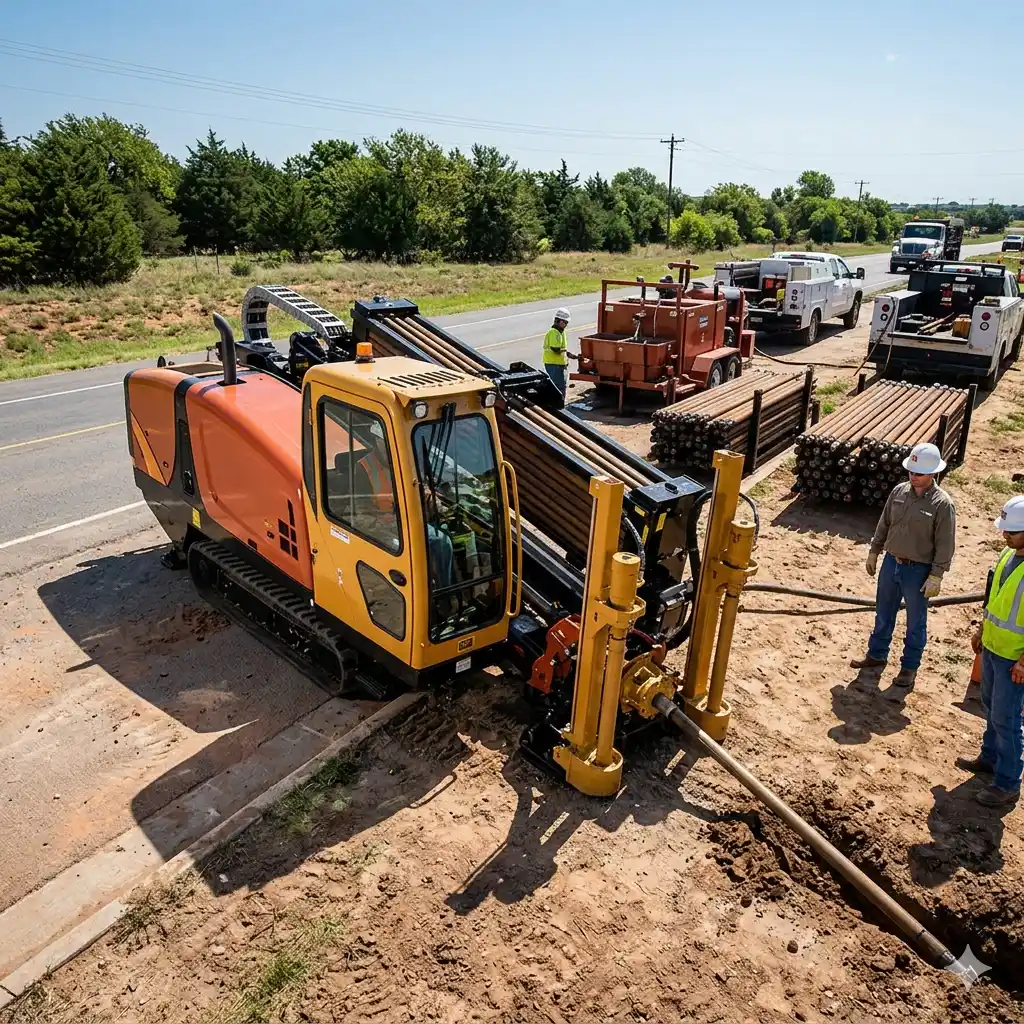
Key features of our Directional Drilling systems
Tunneling GLT offers a comprehensive selection of horizontal directional drills, from compact walk-behind units designed for small-diameter utility installations to high-thrust HDD rigs built for large-scale trenchless construction. Every system in our range is selected and configured for reliability, steering precision, fluid management performance, and ease of operation in demanding field conditions.
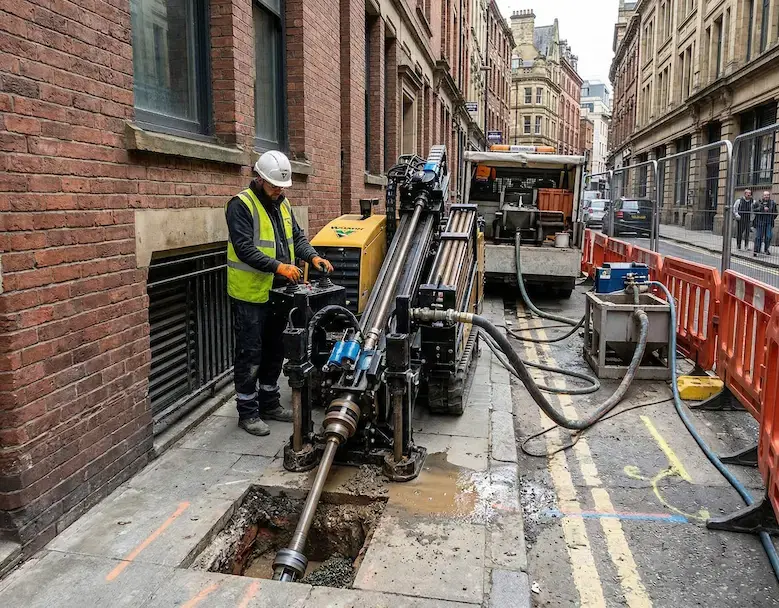
Compact & walk-behind HDD units
Purpose-engineered for urban utility work where access is restricted and surface footprint must be minimised. These machines deliver the steering control and pullback force required for fibre, power, and water service installations with minimal disruption to the surrounding environment.
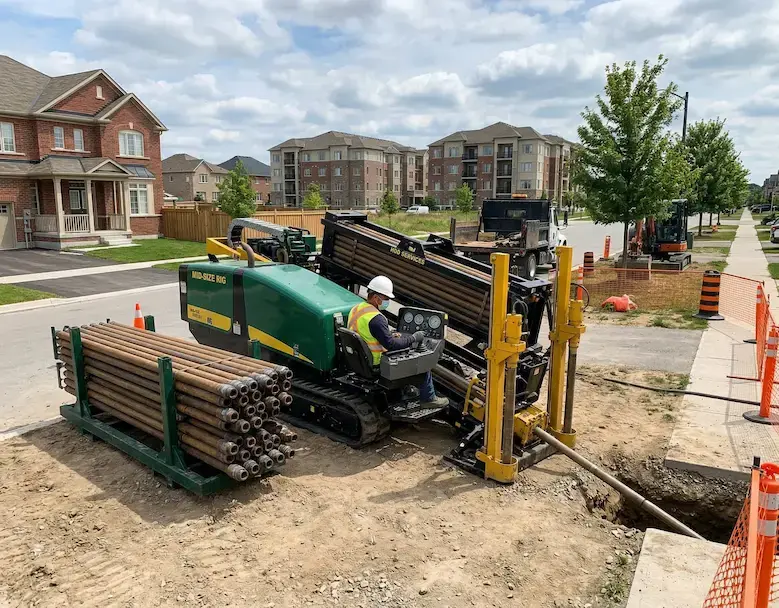
Mid-range directional drilling rigs
The mid-range category covers the broadest spectrum of HDD applications — water mains, gas lines, sewer laterals, and multi-conduit power crossings. These rigs offer an optimised balance of pullback capacity, thrust force, and fluid management system capacity for projects requiring diameters from 100 mm to 400 mm.
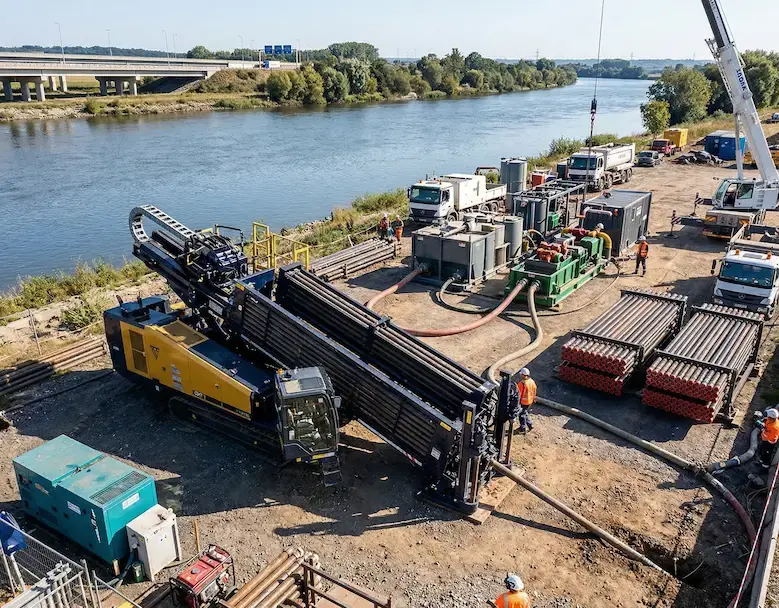
High-thrust HDD rigs forlarge-bore crossings
For infrastructure crossings — river crossings, motorway underpasses, rail alignments, and long-distance pipeline installations — Tunneling GLT supplies high-thrust directional boring machines capable of sustained pullback forces measured in hundreds of thousands of pounds. These rigs are typically paired with high-volume fluid management and mud recycling systems to maintain borehole stability throughout extended drives.
Directional boring equipment applications
Horizontal directional drilling equipment supplied by Tunneling GLT is deployed across the full range of underground utility and infrastructure installation sectors. Each HDD system is configured to meet the specific diameter, ground condition, and project duration requirements of the application.
Utility & Telecommunications
Water Mains & Sewer Lines
Gas & Petrochemical Pipelines
Road & Railway Crossings
River & Marine Crossings
Trusted by leading infrastructure contractors
Tunneling GLT has supplied and supported horizontal directional drilling equipment on major utility and infrastructure projects across Europe, Asia, and Latin America — both as HDD equipment supplier and as technical staffing partner. Here is what project engineers and procurement managers say about our machines and our team.
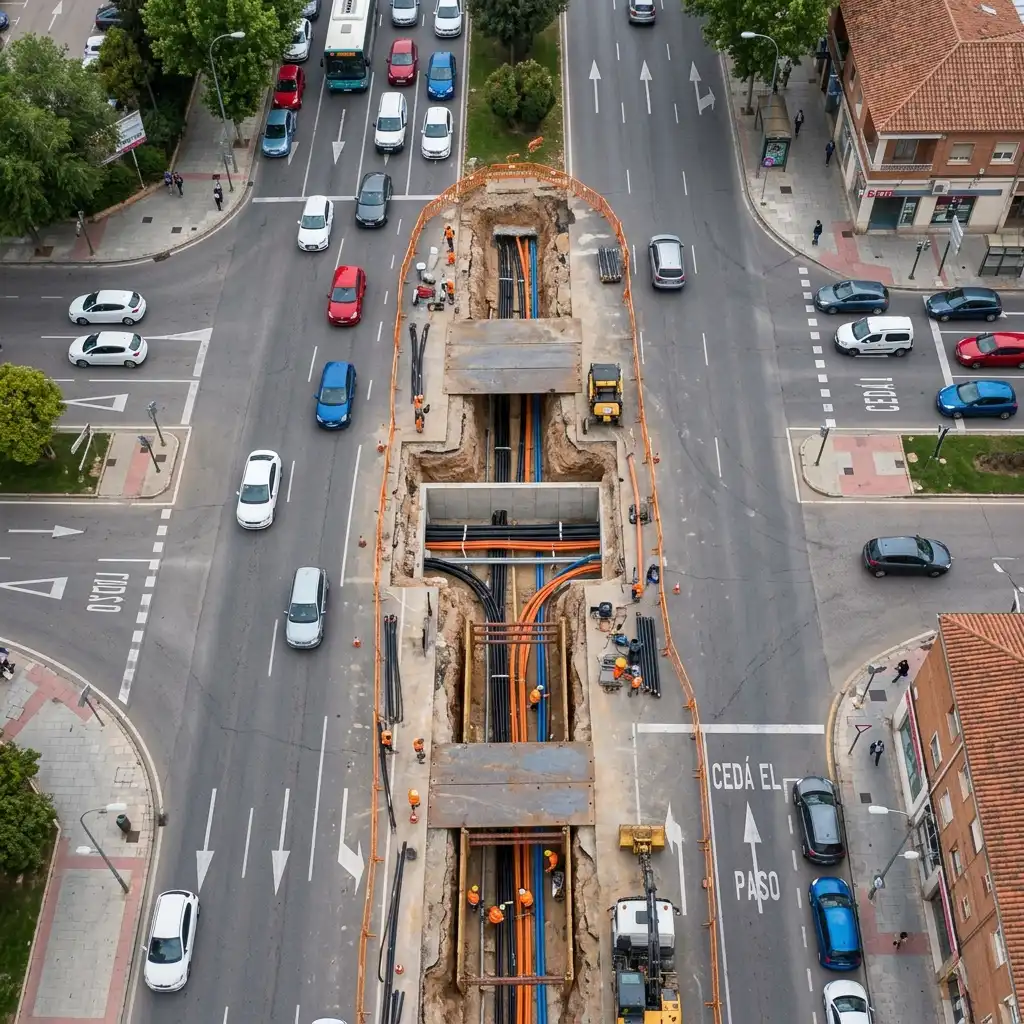

We required a compact HDD unit for a series of urban fibre crossings on a tight programme. Tunneling GLT delivered a fully serviced machine with operator within the week. The project completed on schedule with zero surface damage reported.
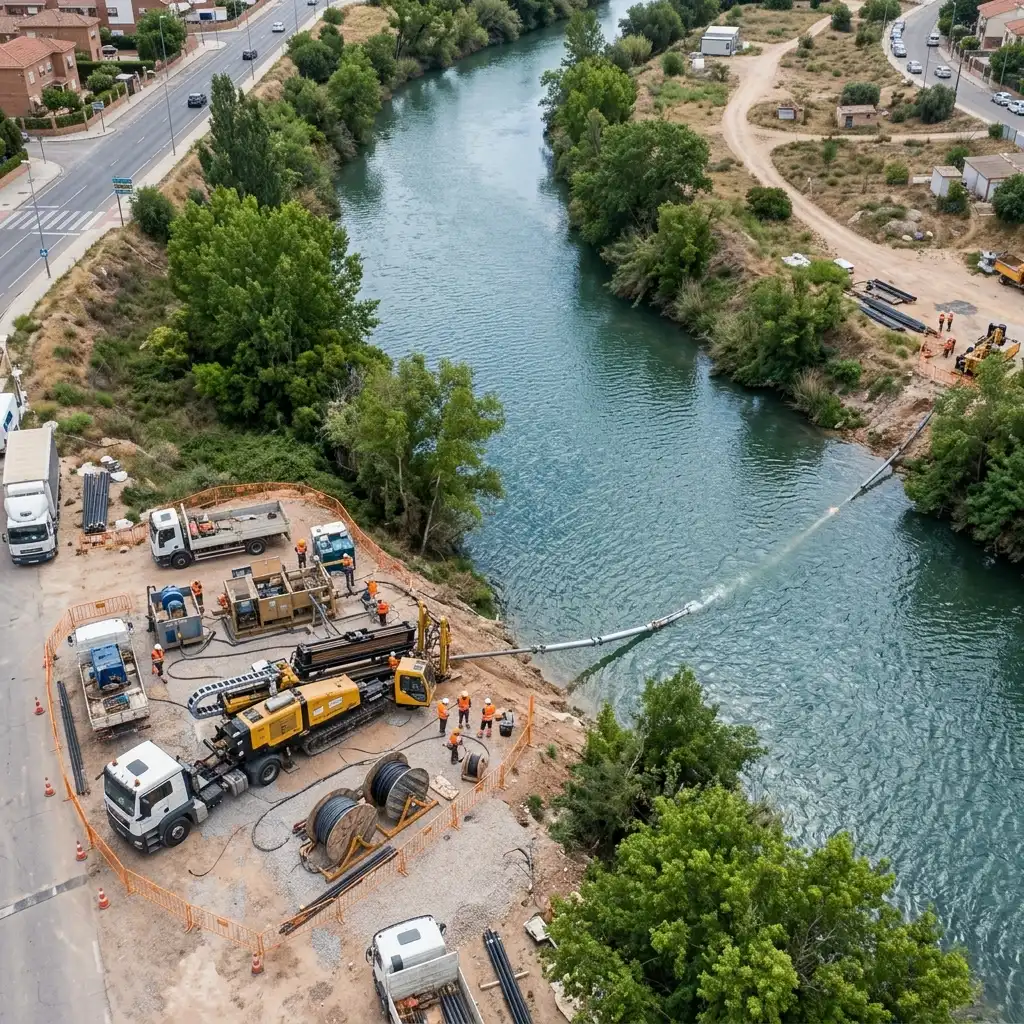
The ground conditions on our river crossing were more variable than anticipated. GLT Tunneling’s technical team adjusted the fluid management programme in real time and maintained borehole integrity throughout. Their expertise was decisive.
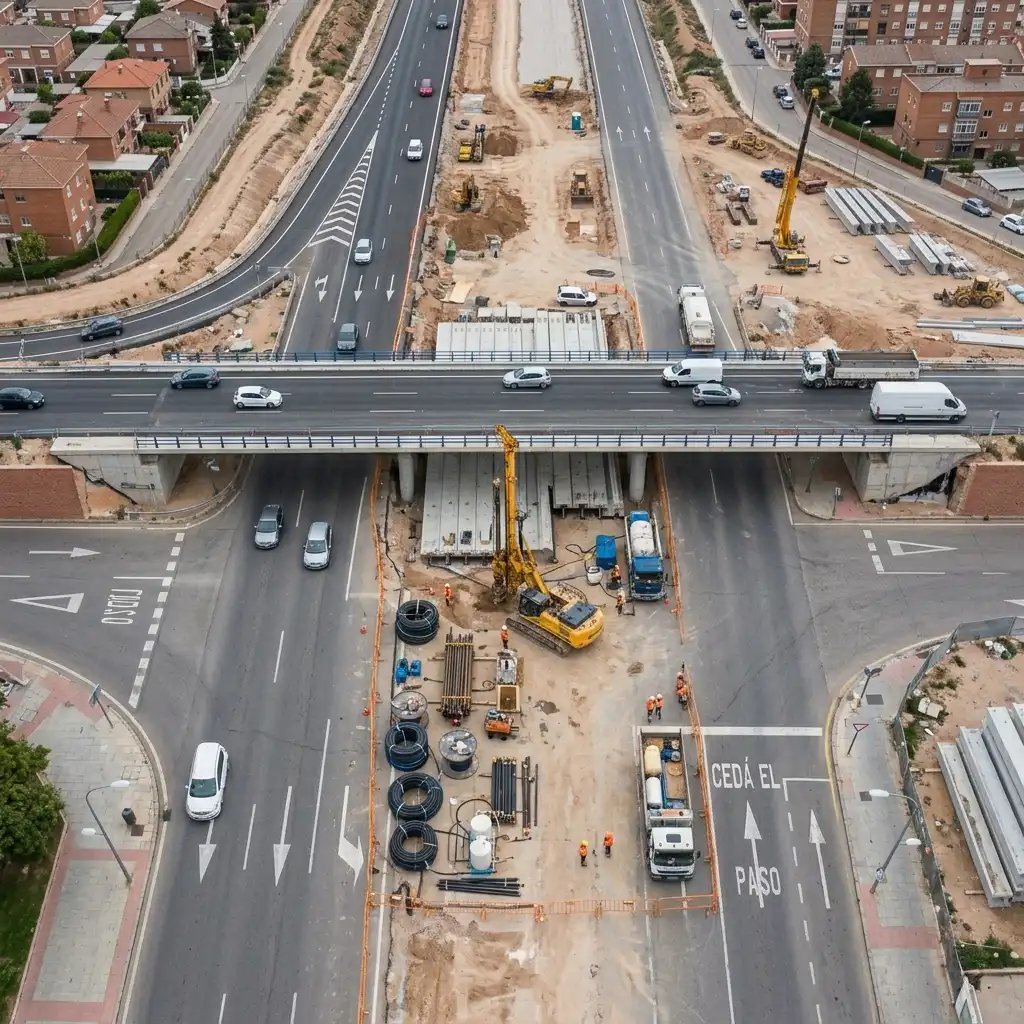
Tunneling GLT supplied and supported a high-thrust HDD rig for a multi-crossing motorway programme. On-site technical support was available throughout, and machine uptime exceeded our contractual requirements on every section.
Ready to discuss your directional drilling requirements?
Tunneling GLT supplies, configures, and supports horizontal directional drilling equipment for infrastructure projects worldwide. Whether you require a compact HDD unit for a single utility crossing, a high-thrust rig for a major infrastructure programme, or technical advisory on ground conditions and fluid management strategy, our team is ready to provide a detailed technical and commercial proposal.
Some related services
Everything you need to know about directional boring machines and directional drilling systems.
What is a directional boring machine and how does it work?
A directional boring machine — also referred to as an HDD rig or horizontal directional drill — is a steerable, trenchless excavation system used to install underground utilities and pipelines along a pre-engineered curved path without the need for open-cut excavation. The machine completes the installation in three defined operational phases.
Phase 1 — Pilot Bore: A drill string fitted with a steerable drill head is advanced through the ground from a launch pit, following a pre-calculated bore path. A sonde (locating transmitter) housed behind the drill head transmits real-time position data to a surface locator system, enabling the operator to monitor and correct the bore trajectory continuously. Steering corrections are made by rotating the drill head to adjust the orientation of the angled face, redirecting the bore path laterally or vertically as required.
Phase 2 — Reaming: Once the pilot bore is complete, the drill head is replaced by a back-reamer of larger diameter. The reamer is pulled back through the pilot bore while simultaneously rotating and pumping drilling fluid, progressively enlarging the borehole to the diameter required to accommodate the product pipe.
Phase 3 — Pullback: The product pipe — pre-assembled on the surface — is attached to the reamer and pulled back through the enlarged bore as the reamer completes its final pass. The drill pipe is simultaneously extracted from the entry side. On completion, the product pipe occupies the full bore path, ready for connection and commissioning.
Throughout all three phases, drilling fluid (typically a bentonite-water slurry or polymer-based fluid) is pumped continuously through the drill string to cool the cutting head, lubricate the bore, carry excavated cuttings to the surface, and maintain borehole stability. Effective fluid management is critical to borehole integrity, particularly in unstable or permeable ground.
What are the main types of directional boring machine?
Horizontal directional drilling machines are classified primarily by their thrust/pullback capacity and the ground conditions for which they are designed:
Compact HDD Units (up to approximately 10,000 lbs pullback): Walk-behind or mini-HDD machines designed for small-diameter utility work — fibre-optic conduits, low-pressure gas service lines, and water service connections. Their small footprint makes them well suited to urban environments, narrow access corridors, and projects where mobilisation cost and speed are priorities.
Mid-Range HDD Rigs (approximately 10,000–100,000 lbs pullback): The most widely deployed category, covering the majority of utility and distribution pipeline installation work. These rigs handle bore diameters from approximately 100 mm to 400 mm across a wide range of ground conditions. They are the standard choice for water main installations, gas distribution crossings, power cable installations, and telecommunications duct bundles.
Large / High-Thrust HDD Rigs (100,000 lbs pullback and above): Engineered for major infrastructure crossings — river crossings, motorway underpasses, rail alignments, and long-distance high-pressure pipeline installations. These machines require substantial site preparation, significant drill pipe inventory, and high-capacity fluid management and mud recycling systems.
The correct machine size is determined by bore diameter, bore length, soil type, and the pullback force required to install the product pipe. Tunneling GLT provides technical advisory support to assist clients in specifying the correct equipment for their ground conditions and project parameters.
What is the difference between directional boring and auger boring?
Directional boring (HDD) and auger boring are both trenchless installation methods, but they differ significantly in capability, application, and cost profile.
Directional boring (HDD) uses a steerable drill system that can follow a curved three-dimensional bore path — allowing the bore to enter the ground at a low angle, follow a curved profile beneath obstacles, and return to grade at the exit point. HDD is used where the bore must pass beneath a watercourse, road, railway, or other structure at depth. It is suitable for flexible product pipes and can accommodate significant bore lengths.
Auger boring uses a rotating helical auger within a steel casing to advance a straight horizontal bore in a single operation. The method is limited to straight alignments, relatively short bore lengths, and softer to medium-cohesive soils. It is typically used beneath road crossings and embankments where a straight, cased bore is acceptable and ground conditions are suitable.
In summary: HDD offers steering flexibility and longer bore capability at higher equipment cost; auger boring is simpler and more economical for short, straight crossings in appropriate ground conditions.
What ground conditions are directional boring machines suitable for?
Modern horizontal directional drilling equipment is engineered to operate across a wide range of ground conditions, though the appropriate machine type, tooling configuration, and fluid management programme vary significantly depending on the soil or rock classification.
Soft and cohesive soils (clays, silts, soft alluvials): Standard drill heads and bentonite-based drilling fluids provide adequate face support and lubrication. These are typically the most straightforward conditions for HDD.
Sandy and granular soils: Require careful management of drilling fluids and borehole pressure to prevent hydrofracture and surface heave. Polymer-enhanced fluids are commonly used in these conditions to maintain borehole stability.
Mixed ground (interbedded clays, sands, and gravels): The most common real-world scenario. Tooling selection and fluid management programmes must be adapted to the changing conditions along the bore path.
Soft rock and weathered rock: Tricone rotary drill heads or PDC (polycrystalline diamond compact) cutters replace standard drag-bit heads. Advance rates are reduced relative to soil bores, and wear on tooling must be planned for.
Hard and competent rock: Directional drilling in hard rock requires specialist rock-rated HDD equipment, purpose-designed rock tooling, and in some cases, downhole mud motors to supplement rotational force. Hard rock directional drilling is a distinct technical specialisation.
Ground investigation data — soil classification, unconfined compressive strength (UCS), groundwater level — is essential input to HDD project planning. Tunneling GLT’s technical team can assist in interpreting geotechnical data and selecting appropriate equipment and tooling configurations.
How much does a directional boring machine cost?
The cost of a directional boring machine varies considerably depending on machine size (thrust/pullback capacity), included ancillary systems, new versus used/refurbished condition, and whether the procurement model is outright purchase, lease, or rental.
As a general principle, compact units for small-diameter utility work represent the lowest capital entry point, while mid-range rigs capable of handling the majority of distribution and utility pipeline work sit in a mid-tier cost bracket. Large, high-thrust machines designed for major infrastructure crossings — and the ancillary systems they require, including high-volume mud recycling units and large-diameter drill pipe inventories — represent a significantly higher capital investment.
Refurbished and used equipment offers a cost-effective alternative for contractors with defined project requirements and appropriate technical capacity to operate and maintain the machine.
Rental and lease arrangements are available for standard machine sizes, allowing access to HDD capability without full capital commitment. Lease terms typically include maintenance provisions and basic technical support.
Tunneling GLT provides transparent, project-specific commercial proposals for equipment purchase, lease, and rental across the full range of machine capacities. Contact our team to discuss your project parameters and obtain a tailored quotation.
Is it possible to purchase a directional boring machine, or can they be rented?
Both purchase and rental/lease arrangements are available for horizontal directional drilling equipment. The most appropriate commercial model depends on project frequency, duration, and financial structure.
Outright purchase is the most cost-effective model for contractors with a pipeline of recurring HDD work. A single machine, properly maintained and refurbished between projects, can be amortised across multiple contracts.
Rental and short-term hire arrangements are well suited to contractors who require HDD capability for a defined project without committing capital. Rental terms vary by machine size and duration and typically include a maintenance package and, in some cases, on-site operator support.
Lease arrangements with options to purchase provide a middle path — allowing contractors to access quality HDD equipment with structured payments while preserving the option to acquire the asset at end of term.
Tunneling GLT can advise on the most commercially advantageous procurement route for your specific project and business requirements.
What diameter of bore can a directional boring machine achieve?
Horizontal directional drilling machines are manufactured and operated across a broad diameter range, depending on machine class and tooling configuration:
- Mini / compact HDD units: Bore diameters from approximately 50 mm to 150 mm — used for fibre-optic conduits, small-diameter water service lines, and gas service connections.
- Mid-range HDD rigs: Bore diameters from approximately 100 mm to 600 mm — used for water mains, gas distribution mains, power cable installations, and multi-conduit utility crossings.
- Large / high-thrust HDD rigs: Bore diameters from approximately 400 mm to over 1,500 mm (1.5 metres) — used for large-diameter pipeline crossings, major infrastructure crossings, and multi-pipe bundles.
The achievable diameter for a given project depends not only on the machine’s reaming capability but also on bore length, ground conditions, available pullback force, and the capacity of the drilling fluid and mud management system. Longer bores and weaker ground conditions generally impose practical limits on the maximum diameter that can be reliably reamed and held open during pullback.
Tunneling GLT’s engineers can assess your project parameters and confirm the appropriate machine and tooling specification for your required bore diameter.
What technical support does Tunneling GLT provide with its directional drilling equipment?
Tunneling GLT provides comprehensive technical support across the full project life cycle for all directional boring equipment supplied:
Pre-project: Ground condition review, equipment specification advisory, bore path design input, fluid management programme development, tooling selection.
Mobilisation: On-site technical assistance during equipment commissioning, crew familiarisation, and initial bore launch.
Operation: On-site and remote technical support, drilling parameter monitoring, tooling wear assessment, and fluid management optimisation throughout the bore programme.
Maintenance: Planned maintenance scheduling, parts supply, and rapid-response technical assistance for mechanical, hydraulic, and electronic system issues.
Crew supply: Certified HDD operators, locating technicians, and site supervisors available for deployment on client projects worldwide.
Refurbishment and resale: Full strip-down, inspection, component replacement, and recommissioning of used HDD equipment for subsequent project deployment.