
Tunnel Boring Machine
What is a Tunnel Boring Machine?
A tunnel boring machine (TBM) is a mechanised tunneling system engineered to excavate tunnels through a wide range of ground conditions — from soft soils to hard rock formations. A rotating cutting head breaks and removes material from the tunnel face continuously, while precast concrete segments are installed behind it to form the permanent tunnel lining.
TBMs operate under pressure balance systems — EPB or slurry — making them suitable for urban environments, underwater crossings, and complex ground conditions. They are the benchmark solution for metro systems, road tunnels, water infrastructure, hydroelectric projects, and underground mining.
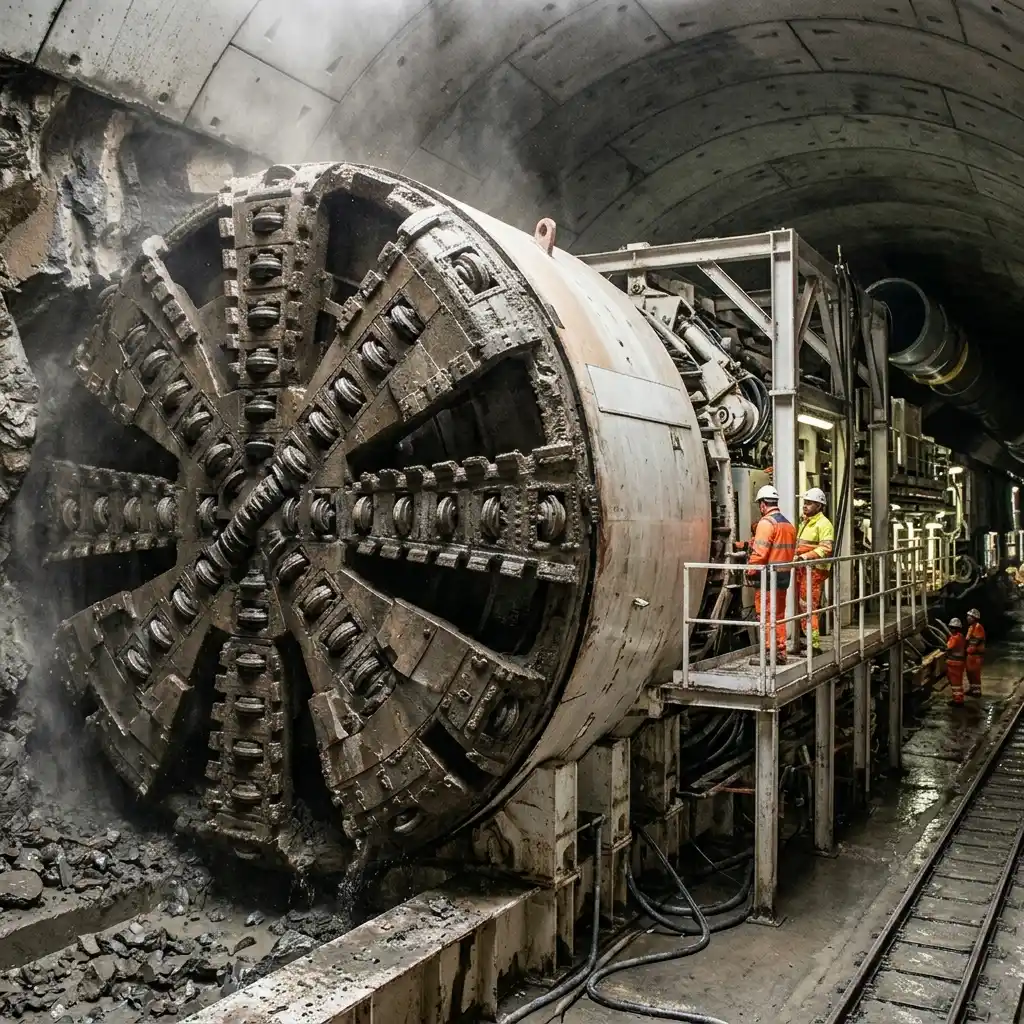
Types of Tunnel Boring Machine
Tunneling GLT engineers, supplies, and supports the full range of TBM types. Each machine is configured to match the specific ground conditions, tunnel diameter, project depth, and hydrogeological constraints of the project. Selecting the correct TBM type is the single most critical decision in tunnel project planning — an incorrect selection results in reduced advance rates, increased ground risk, and significant cost overruns.
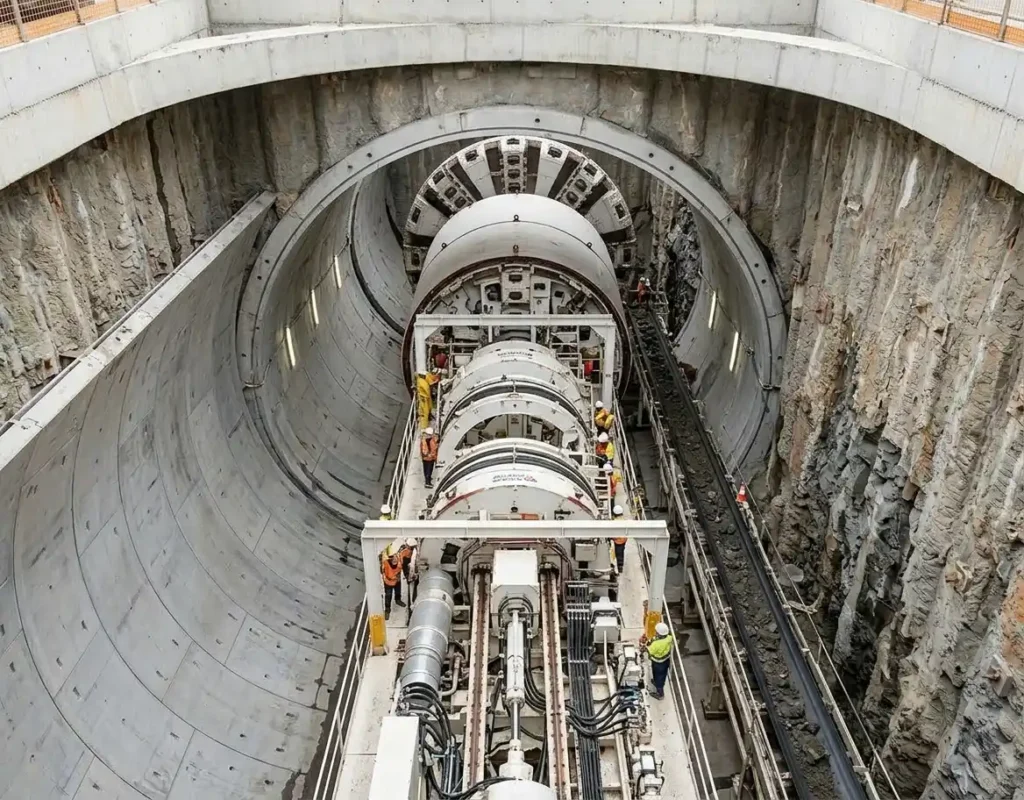
Earth pressure balance TBM (EPB TBM)
The Earth Pressure Balance TBM (EPB TBM) is the most widely deployed machine type for soft ground tunneling in urban environments. The EPB TBM manages face stability by using the excavated material itself — conditioned with foam, bentonite, polymers, or water — to counterbalance the earth and water pressure at the tunnel face, preventing ground settlement and surface subsidence.
EPB TBMs are designed for cohesive and semi-cohesive soils including clays, silts, sands, and mixed ground with elevated groundwater pressure. They are the standard choice for urban metro systems and shallow utility tunnels where settlement control is paramount. Tunnel diameters for EPB machines typically range from 3 to 15 metres.
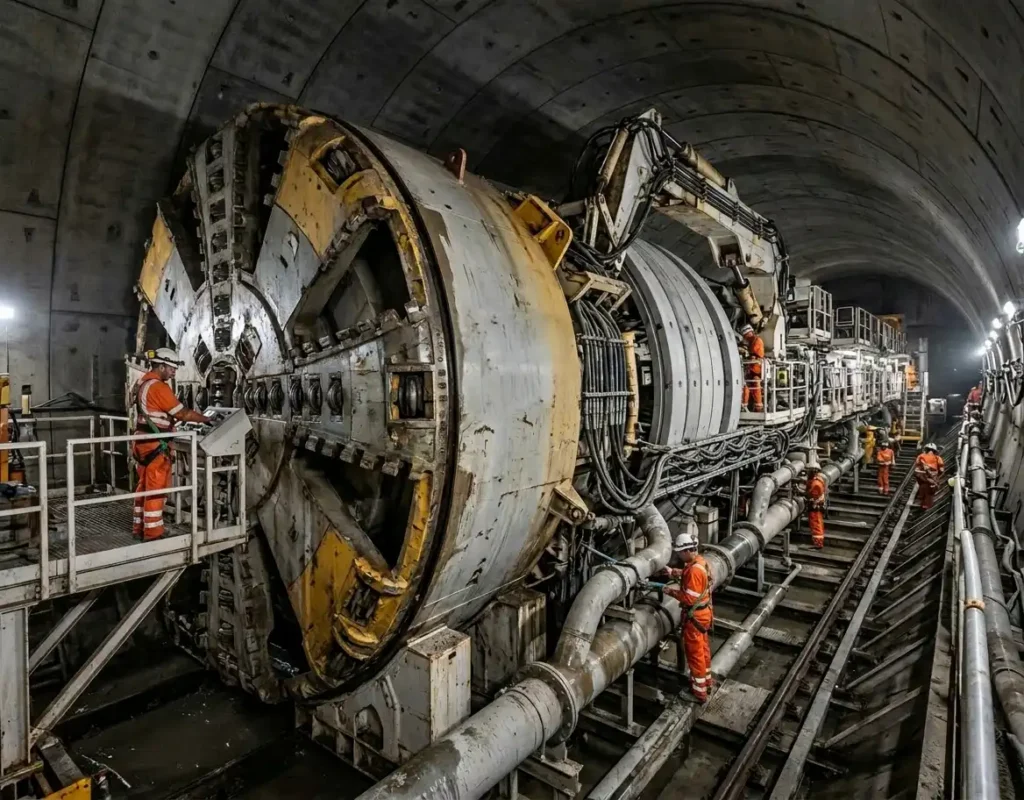
Slurry TBM (Slurry shield)
The slurry tunnel boring machine — also known as a slurry shield TBM — uses a pressurised bentonite slurry circuit to provide continuous hydraulic face support against groundwater and unstable ground. Excavated material is mixed with slurry and pumped back to a surface separation plant, where the solids are extracted and the slurry is reconditioned and recirculated.
Slurry TBMs are the preferred solution for water-saturated ground, permeable gravels, coarse sands, and any tunneling alignment beneath rivers, harbours, marine inlets, or other bodies of water. Their capacity to maintain face pressure with high precision makes them suitable for extremely sensitive surface environments and long-distance subsea crossings.
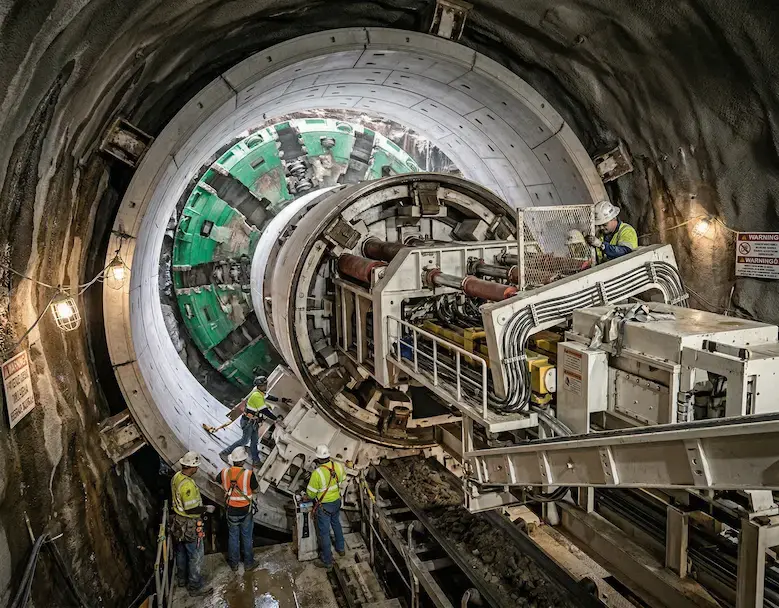
Double shield TBM
The double shield TBM integrates the productive excavation speed of a hard rock open-face machine with the ground-control capabilities of a shielded system. The rear gripper section anchors against the tunnel wall to provide reaction force, while the front shield advances independently. Segment installation proceeds simultaneously with boring, enabling continuous progress.
Double shield TBMs are specifically designed for mixed ground conditions where rock mass quality varies along the alignment — alternating between competent rock and weaker, fractured zones. They achieve high advance rates without sacrificing face stability or lining integrity, making them the preferred choice for long-distance infrastructure tunnels in mountainous or geologically complex terrain.
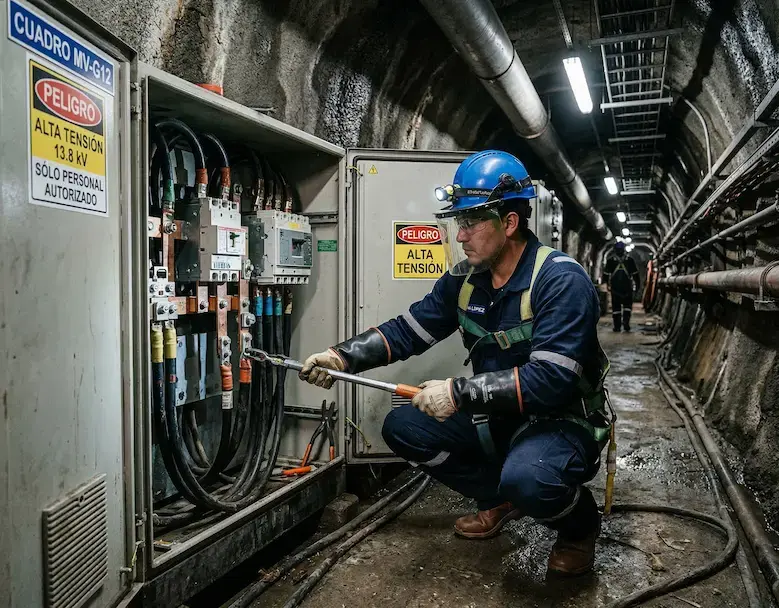
Hard rock TBM (Open-Face / Gripper TBM)
The hard rock TBM — also referred to as an open-face TBM or gripper TBM — is engineered for stable, competent rock formations. The machine advances by thrusting tungsten carbide disc cutters against the rock face under high thrust loads, causing the rock to fracture and break away as chips. Gripper pads extend laterally against the tunnel walls to provide the reaction force required for forward propulsion.
Hard rock TBMs are the most productive machine type in terms of advance rate when ground conditions are appropriate — achieving penetration rates that manual and drill-and-blast methods cannot match. They are deployed in hydroelectric headrace and tailrace tunnels, deep infrastructure projects, mining access tunnels, and water conveyance systems in hard rock geology.
Tunnel Boring Machine applications
Tunnel boring machines supplied and supported by Tunneling GLT are deployed across the full spectrum of civil engineering and infrastructure sectors. From short-distance utility crossings to multi-kilometre metro alignments, each TBM is configured to deliver the required performance, safety standards, and advance rates that the specific project demands.
Metro & Rail Tunnels
Road & Highway Tunnels
Water & Sewer Tunnels
Hydroelectric Tunnels
Mining & Industrial
Trusted by leading infrastructure companies
Tunneling GLT has supported major tunnel construction projects across Europe, Asia, and Latin America — both as TBM supplier and as technical staffing partner. Here is what project managers and construction directors say about our machines and our people.
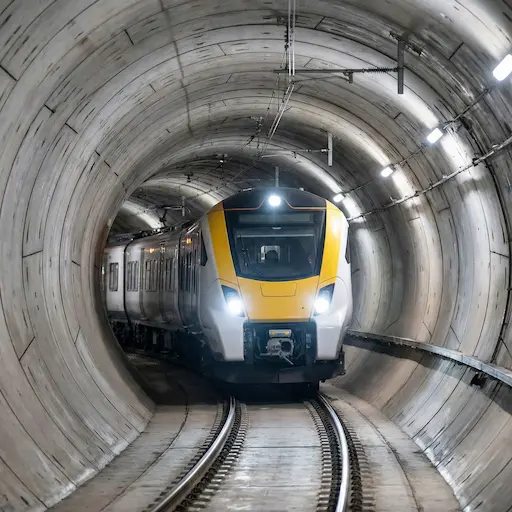

We required two experienced TBM operators and an erector operator at very short notice for a critical metro tunneling project. GLT Tunneling delivered certified professionals within days. Their operators took command of the machine immediately and sustained our planned advance rates throughout the contract period.
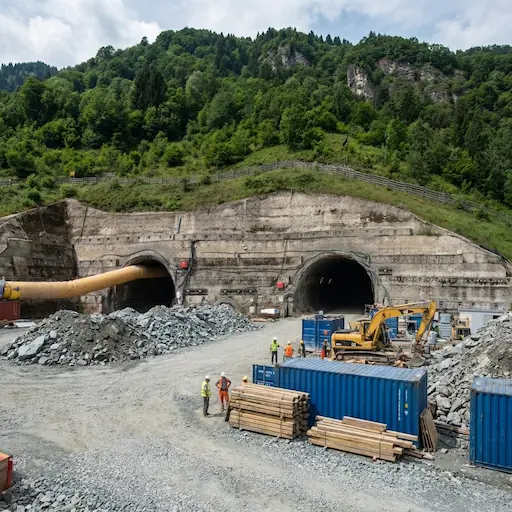
A hydraulic failure mid-project placed our schedule at serious risk. GLT Tunneling dispatched a TBM hydraulic mechanic and a TBM electrician within 48 hours. Both technicians diagnosed and resolved the failure rapidly and remained on site for the full project duration. Their depth of technical knowledge was exceptional.
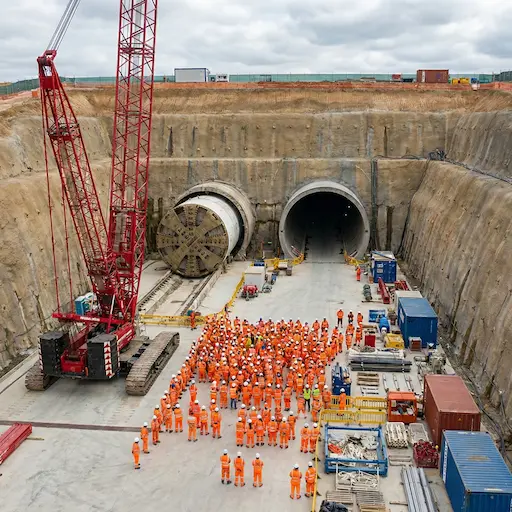
For a large-scale infrastructure tunnel we required a complete logistics team — locomotive drivers, conveyor belt operators, and general TBM support personnel. GLT Tunneling assembled that team from the ground up. Three projects later, they remain our first call for underground construction staffing.
Ready to speak with a Tunnel Boring Machine manufacturer?
Tunneling GLT has been engineering and supplying custom tunnel boring machines for civil infrastructure projects worldwide. Whether you need a new TBM, a refurbished machine, technical support, or a complete project crew, our team is ready to provide a tailored technical and commercial proposal for your specific ground conditions and project requirements.
Some related services
Everything you need to know about tunnel boring machines, TBM types, specifications, and procurement.
What is a tunnel boring machine (TBM) and how does it work?
A tunnel boring machine (TBM) is a full-face mechanised excavation system used to construct tunnels in a single, continuous pass. The machine is composed of a rotating cutting head at the front, a shield body that supports the ground around the excavation, and an extensive trailing system of gantries — known as the backup — which house the conveyor, hydraulic systems, segment supply, electrical equipment, and ventilation.
The cutting head rotates under hydraulic thrust and torque, breaking the ground material through disc cutters (in hard rock) or drag bits and scrapers (in soft ground). The excavated material falls into a screw conveyor or slurry pump and is transported to the surface. Behind the cutting head, a ring of precast concrete segments is assembled by an erector arm to form the permanent tunnel lining. The TBM then thrusts forward against these completed rings to advance.
Modern TBMs are fully equipped with real-time monitoring systems for face pressure, advance rate, torque, thrust force, grouting pressure, and tail seal performance, allowing the operator and geotechnical team to continuously optimise machine parameters and respond to changing ground conditions.
What are the main types of tunnel boring machine?
There are four principal TBM types in common use, each designed for specific ground conditions:
1. Earth Pressure Balance TBM (EPB TBM): Used in soft, cohesive soils (clays, silts, sands) with groundwater. The EPB TBM uses conditioned excavated material to maintain face stability. It is the standard type for urban metro and utility tunnels.
2. Slurry TBM (Slurry Shield): Used in water-saturated, highly permeable, or granular ground. A bentonite slurry circuit maintains face pressure. Preferred for subsea crossings, river crossings, and deep urban tunnels in coarse soils.
3. Double Shield TBM: Used in mixed or variable ground conditions, particularly where rock quality changes along the tunnel alignment. Combines gripper propulsion with a protective shield and simultaneous segment installation.
4. Hard Rock TBM (Open-Face / Gripper TBM): Used exclusively in stable, competent rock. Achieves the highest advance rates of any TBM type in appropriate geology. Used in hydroelectric tunnels, mining, and deep infrastructure.
The correct machine type is determined through a thorough ground investigation programme, geotechnical risk assessment, and tunnel alignment study. GLT Tunneling provides specialist technical advisory services to assist clients in selecting the optimal TBM configuration for their project.
What is the cost of a tunnel boring machine?
The cost of a tunnel boring machine varies significantly depending on the machine type, tunnel diameter, technical specifications, and project-specific requirements. As a general principle, larger diameters, more complex ground conditions, and higher performance requirements all increase the cost of the machine and its associated systems.
Refurbished or reconditioned TBMs represent a cost-effective alternative to new-build machines, with pricing dependent on the extent of refurbishment required and the original machine’s provenance and operating history.
Additional project costs to budget beyond the TBM itself include: backup system procurement, segment supply, launch shaft construction, slurry treatment plant (if applicable), and the full operational logistics chain.
GLT Tunneling provides transparent, project-specific TBM cost estimates and full life-cycle commercial proposals. Contact our team to discuss your project parameters and obtain a tailored quotation.
Is it possible to purchase a tunnel boring machine, or are they typically leased?
Both purchase and lease arrangements are available in the TBM market. The most appropriate commercial model depends on the project duration, the client’s long-term pipeline, and financial structure.
Outright purchase is common for contractors with multiple sequential tunnel projects, as a single TBM can be refurbished and re-launched on successive contracts, amortising the capital cost across several projects.
Lease or rental arrangements are increasingly available for standard machine sizes and types, allowing contractors to access high-quality TBMs without committing full capital outlay. Lease terms typically include maintenance provisions and technical support from the supplier.
Turnkey supply — in which the TBM supplier takes responsibility for the complete excavation operation, including staffing, maintenance, and performance targets — is also an option for clients who require guaranteed production outputs.
Tunneling GLT can advise on the most commercially advantageous procurement route for your specific project and financial requirements.
What diameter of tunnel can a TBM excavate?
Tunnel boring machines are manufactured across an extremely wide range of diameters:
- Micro TBMs / pipe jacking machines: 0.5 to 2 metres — used for utility crossings, gravity sewers, and service ducts beneath roads and railways.
- Small-diameter TBMs: 2 to 4 metres — used for utility tunnels, cable tunnels, and small-diameter water mains.
- Medium-diameter TBMs: 4 to 8 metres — the most common class; used for metro tunnels, rail tunnels, and medium-section road tunnels.
- Large-diameter TBMs: 8 to 14 metres — used for dual-bore metro tunnels, combined service tunnels, and highway tunnels.
- Ultra-large TBMs: over 14 metres — among the largest engineering machines ever built, used for large-highway tunnels and bored cut-and-cover alternatives.
The world’s largest TBMs have excavated tunnels exceeding 17 metres in diameter. Machine diameter directly affects cutting head design, thrust requirement, segment geometry, and logistical complexity. Tunneling GLT engineers custom TBM configurations for any diameter requirement.
What ground conditions are TBMs suitable for?
TBM advance rates and overall project duration depend on tunnel diameter, length, ground conditions, machine type, and crew performance. Typical average advance rates range from 8 to 30 metres per day for soft ground machines, and from 15 to 50 metres per day for hard rock machines under optimal conditions. Best-in-class hard rock TBMs have achieved over 100 metres per day on favourable short drives.
For project planning purposes, a 5-kilometre urban metro tunnel in mixed ground with an EPB TBM typically requires between 18 and 36 months from TBM launch to breakthrough, including mobilisation, intervention periods, and segment installation. Hard rock tunnels of similar length may be completed in 12 to 24 months.
GLT Tunneling’s project engineers can provide realistic schedule assessments based on the specific geotechnical, logistical, and contractual parameters of each project.
How long does it take to build a tunnel with a TBM?
TBM advance rates and overall project duration depend on tunnel diameter, length, ground conditions, machine type, and crew performance. Typical average advance rates range from 8 to 30 metres per day for soft ground machines, and from 15 to 50 metres per day for hard rock machines under optimal conditions. Best-in-class hard rock TBMs have achieved over 100 metres per day on favourable short drives.
For project planning purposes, a 5-kilometre urban metro tunnel in mixed ground with an EPB TBM typically requires between 18 and 36 months from TBM launch to breakthrough, including mobilisation, intervention periods, and segment installation. Hard rock tunnels of similar length may be completed in 12 to 24 months.
Tunneling GLT project engineers can provide realistic schedule assessments based on the specific geotechnical, logistical, and contractual parameters of each project.
What technical support does GLT Tunneling provide with its TBMs?
Tunneling GLT provides comprehensive technical support throughout the full project life cycle:
- Pre-project: Ground condition analysis, TBM type selection advisory, machine specification development, procurement support.
- Manufacturing and assembly: Quality oversight during TBM production and factory acceptance testing (FAT).
- Mobilisation: On-site technical assistance during TBM assembly, commissioning, and initial launch.
- Operation: Ongoing remote and on-site technical support, performance monitoring, and cutterhead inspection advisory.
- Maintenance: Planned maintenance scheduling, parts supply, and emergency response for hydraulic, electrical, and mechanical systems.
- Crew supply: Certified TBM operators, erector operators, TBM electricians, hydraulic mechanics, and full site management teams available for deployment worldwide.
- Refurbishment: Full TBM strip-down, component replacement, and reconditioning for re-use on subsequent projects.